

Reinforced concrete columns form the backbone of modern construction, transferring loads from beams, roofs, and floors down to the foundation. Understanding the critical components and processes involved in column construction ensures structural integrity, safety, and longevity. This comprehensive guide examines the six fundamental elements of reinforced concrete column construction.
Understanding Reinforced Concrete Columns
A reinforced concrete (RC) column is a vertical structural element designed to carry compressive loads while maintaining stability. These columns support loads from beams, roofs, and floors while distributing the weight to the foundation. The combination of concrete’s compressive strength and steel’s tensile capacity creates a composite structural system far superior to either material alone.
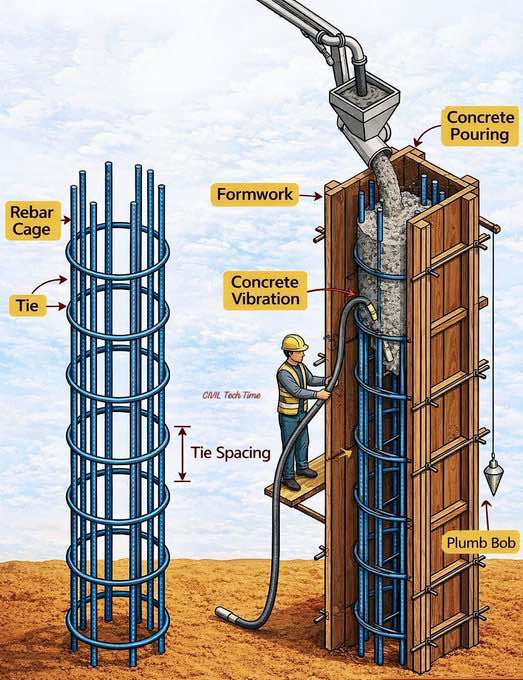
The Six Critical Components of Column Construction
1. Rebar Cage: The Tensile Strength Provider
The rebar cage represents the skeletal framework of a reinforced concrete column. Concrete is strong under compression but has low tensile strength, and rebar is cast into it to carry the tensile loads. This fundamental principle underlies all reinforced concrete construction.
Longitudinal Reinforcement
The principal role of longitudinal reinforcing steel is to resist stresses due to bending and tension. These vertical bars run the entire height of the column and are the primary load-bearing elements of the rebar cage.
Design codes establish specific requirements for longitudinal reinforcement:
- According to ACI 318-19, section 10.7.3, the minimum number of bars for concrete columns are four within rectangular or circular ties
- The reinforcement ratio must fall between 1% and 8% of the gross column area
- The lower limit of 1% provides a minimum amount of steel to protect against tension failures due to unanticipated bending moments; the upper limit of 8% prevents overcrowding of steel bars within the concrete formwork
In practice, most columns are designed with reinforcement ratios around 4% to reduce steel congestion and ensure proper concrete consolidation.
Material Properties
Steel and concrete have similar coefficients of thermal expansion, so a concrete structural member reinforced with steel will experience minimal differential stress as the temperature changes. This thermal compatibility is crucial for long-term structural performance.
Rebar surfaces feature a continuous series of ribs, lugs or indentations to promote a better bond with the concrete and reduce the risk of slippage. These deformations are essential for transferring forces between steel and concrete.
Assembly Methods
Rebar cages are normally tied together with wire, although spot welding of cages has been the norm in Europe for many years and is becoming more common in the United States. Wire tying remains the predominant method because it keeps the steel cool and preserves its mechanical properties.
2. Ties (Stirrups): Preventing Bar Buckling and Confining Concrete
Transverse reinforcement in the form of ties or stirrups serves multiple critical functions in column construction.
Primary Functions
There are four primary purposes of transverse reinforcement bars: resisting the shearing forces that act on a drilled shaft, holding the longitudinal steel in place during construction, providing the drilled shaft with enough resistance against compressive or flexural stresses, and confining the concrete in the core of the cage to give the drilled shaft post-yield ductility.
Design Requirements
Building codes specify precise requirements for tie reinforcement:
- For concrete columns made with concrete having a specified compressive strength greater than 12,000 psi, the free ends of rectangular ties shall terminate with a 135-degree standard tie hook
- Tie spacing and size must be carefully calculated based on column dimensions and longitudinal bar sizes
- The spaces between must follow the drawing, and hooks must be properly bent at right angles
Spacing Considerations
Proper tie spacing is essential for structural performance. Maximum clear spacing of 75 mm is specified, with minimum clear spacing being the greatest of 25 mm or four-thirds times the diameter of aggregate.
3. Formwork (Shuttering): Shaping the Column
Formwork creates the temporary mold that shapes the column during concrete placement and curing.
Definition and Purpose
Formwork in concrete construction is used as a mold for a structure in which fresh concrete is poured only to harden subsequently. The quality and design of formwork directly impact the accuracy, dimensions, and surface finish of the final column.
Material Options
Several materials are commonly used for column formwork:
Timber Formwork: Timber formwork is easy to construct using locally available timber and is lightweight as compared to steel or aluminum shuttering. While economical for small projects, timber has limitations in reusability and durability.
Steel Formwork: Steel shuttering offers very smooth and leveled finishes to the concrete surface and is best suited for circular or curved structures such as tanks, columns, chimneys, sewers, tunnels, and retaining walls. It can be used more than 100 times and does not absorb moisture from the concrete surface.
Aluminum Formwork: Aluminum formwork combines lightweight properties with high strength, making it particularly suitable for high-rise and fast-paced construction projects, with excellent reusability often exceeding 200 cycles.
Key Components
Column shuttering consists of panels typically made from materials like plywood, steel, or aluminium which form the mold for the column, with tie rods preventing lateral movement, clamps helping adjust pressure, wedges creating pressure to keep formwork intact, and diagonal braces supporting the formwork to prevent bowing or shifting during the concrete pour.
Critical Requirements
Construction of formwork should permit removal of various parts in desired sequences without damage to the concrete, the material should be cheap and readily available, and it should be set accurately to the desired line and levels with a plane surface.
4. Concrete Pouring: Filling the Mold
The concrete pouring process demands precision and adherence to best practices to prevent defects.
Pouring Technique
Concrete should not freefall from a distance of more than 1.5 meters to avoid honeycomb defects. When pouring from heights above 2 meters, chutes or slides should be used to control concrete placement.
Layered Approach
Layered pouring allows concrete to densify step by step, effectively preventing honeycombing. This systematic approach ensures uniform distribution and proper consolidation throughout the column height.
Mix Design Considerations
The concrete mix should have an appropriate amount of fine aggregate particles because the fine aggregate particles will seal the voids and gaps between the coarse aggregate particles easily and properly. Proper workability is essential for concrete to flow around reinforcement and fill the formwork completely.
5. Concrete Vibration: Eliminating Air Voids
Vibration is perhaps the most critical step in preventing defects and ensuring column quality.
Purpose of Vibration
Inadequate vibration during placing of concrete may cause formation of air voids and may also affect proper compaction. The vibration process serves to consolidate the concrete, remove trapped air, and ensure complete filling of the formwork.
Preventing Honeycomb
Honeycomb refers to voids or cavities in hardened concrete that resemble a honeycomb structure. Proper compaction can be achieved by using vibrating equipment such as poker vibrators that can penetrate the concrete and dislodge air bubbles trapped in the mixture.
The consequences of inadequate vibration include:
- Poor mixing quality, insufficient compaction, and inadequate vibration can leave air pockets that manifest as honeycombs, which can severely impact structural integrity
- A reinforcement ratio higher than 0.08 times the gross area leads to steel congestions that hinder proper placement and concrete consolidation, and steel congestion may lead to the formation of honeycomb in concrete
Vibration Technique
Control vibration at each point for 20-30 seconds, with additional time if needed, to ensure complete compaction. Systematic vibration throughout the pour prevents segregation while eliminating air pockets.
Classification of Honeycomb Defects
Understanding honeycomb severity helps determine remedial actions:
- Small honeycombs are typically less than 10mm in size and generally not a structural concern but can affect aesthetic appearance
- Medium-sized honeycombs are typically between 10mm and 50mm and can reduce the strength and durability of concrete, requiring remediation
- Large honeycombs are typically greater than 50mm in size and significantly affect structural strength, usually requiring excessive reinforcement or replacement
6. Plumb Bob: Ensuring Vertical Alignment
Vertical alignment is fundamental to column performance and overall structural integrity.
Function and Principle
A plumb bob uses gravity to ensure that the string hangs perfectly vertical, providing high precision in establishing true vertical lines. This simple tool has been used for thousands of years and remains relevant in modern construction.
Application in Column Construction
The plumb bob is used to check the vertical alignment of structural components such as walls, posts, columns, and even pipes, and workers use it to ensure that the frame or wall studs are vertically aligned with the foundation.
Columns carry the load of a structure and are critical, so it is important to align columns vertically so that the load will be transmitted properly.
Usage Method
Attach a plumb bob to the top of the column, allow it to hang freely and align it with the column, then measure the distance between the plumb line and the column at different heights. Any variation in these measurements indicates the column is not vertical and requires adjustment.
Modern Alternatives
While laser levels and theodolites are now common, the plumb bob remains relevant because it is unaffected by weather conditions and can be used in any environment, ensuring that vertical measurements remain consistent even in the harshest settings.
Quality Control and Inspection
Pre-Pour Checklist
Column reinforcement works must follow checklists on site: the numbers and diameter of vertical bars must be checked, development length must be checked as it depends upon bar diameter, lapping in alternate bars must come at similar height and must not come inside the beam or slab, spaces between must follow the drawing, and hooks must be properly bent at right angles.
Formwork Verification
Check that the formwork is rigid, well braced and watertight, as improper formwork will lead to penetration of air and water pockets. Leaky formwork can result in loss of cement paste and honeycomb formation.
Concrete Placement
Concrete should be placed with precision and care to ensure that segregation does not occur and that all materials are adequately compact. Careful placement prevents many common defects.
Common Defects and Prevention
Honeycomb Prevention
Multiple factors contribute to honeycomb prevention:
- Use the right mix design with good workability and aggregate gradation, proper and effective vibration to burst trapped air bubbles, and maintain reinforcement spacing
- Ensure formwork is properly sealed before concrete placement
- Control pouring height to prevent segregation
Steel Congestion
The majority of columns are designed with a maximum reinforcement ratio of 0.04 times the gross area, which considerably reduces the chance of congestion and the use of large steel bars can reduce steel congestion.
Structural Design Considerations
Load Transfer
The RCC slab spreads loads to the beams, beams carry these loads horizontally and send them to the vertical columns, and columns pass the forces down to the footings which distribute them to the ground. This clear load path is essential for structural stability.
Design Factors
Several factors influence RC column design: the type and magnitude of loads including gravity loads, lateral loads, and environmental loads; exposure to environmental elements such as moisture, aggressive chemicals, and temperature variations; and local building codes and industry standards that prescribe minimum requirements.
Conclusion
Reinforced concrete column construction relies on six interconnected components working in harmony. The rebar cage provides tensile strength while ties prevent buckling and confine concrete. Formwork shapes the column precisely, while proper concrete pouring and vibration eliminate defects. Finally, plumb bobs ensure perfect vertical alignment.
Success in column construction demands attention to detail at every stage. From accurate reinforcement placement and robust formwork design to systematic concrete placement and thorough vibration, each step contributes to the final structural performance. Following established codes, conducting proper inspections, and maintaining quality control throughout the process ensures columns that are safe, durable, and capable of supporting their intended loads for the structure’s design life.
Understanding these fundamental principles empowers construction professionals to deliver high-quality reinforced concrete columns that form the reliable backbone of modern buildings and infrastructure.
Discover more from Makao Bora
Subscribe to get the latest posts sent to your email.


Join The Discussion